Showing posts with label organ. Show all posts

Wednesday, August 3, 2016

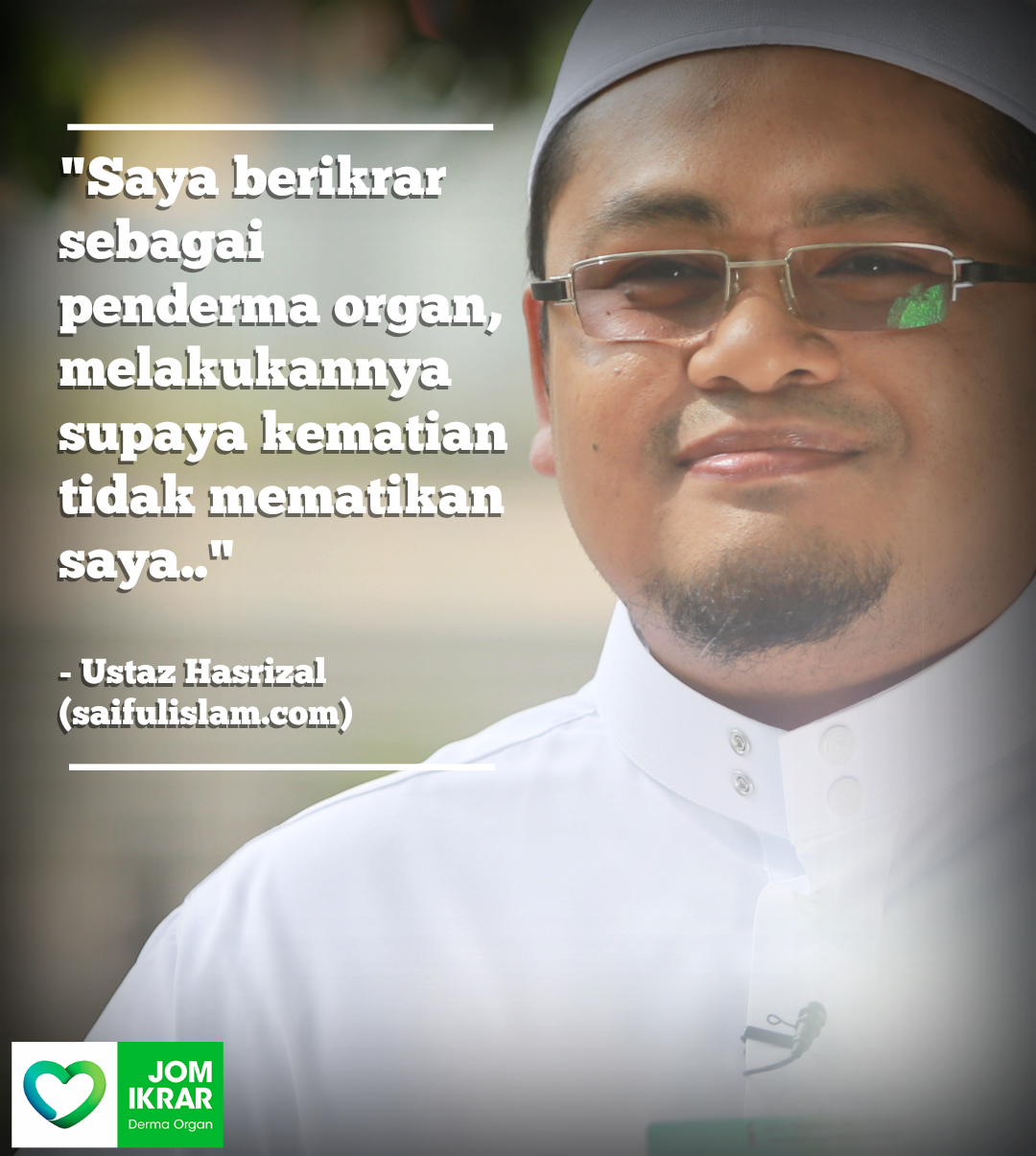
5 sebab mengapa anda perlu IKRAR derma organ


Sejak ditubuhkan pada 1997, Pusat Sumber Transplan Nasional sentiasa menyeru masyarakat supaya mendaftarkan diri sebagai pengikrar penderma organ melalui kempen, ceramah, iklan dan lain-lain. Walaubagimanapun, sehingga hari ini, hanya sekitar 1% sahaja rakyat Malaysia yang berdaftar sebagai pengikrar penderma organ. Masih ramai lagi masyarakat yang belum mempunyai kesedaran untuk mendermakan organ sedangkan jumlah pesakit yang menunggu untuk rawatan pemindahan organ terus meningkat.

JADI, MENGAPAKAH ANDA PERLU IKRAR SEBAGAI PENDERMA ORGAN?

1) Menjadikan anda seorang yang lebih sihat


Bukan semua orang yang berdaftar sebagai pengikrar penderma organ mempunyai potensi yang sama untuk menjadi penderma sebenar. Ini adalah disebabkan faktor kesihatan yang kadangkala menjadi penghalang dari ia berlaku. Dengan mendaftar sebagai pengikrar penderma organ, anda diseru untuk sentiasa mengamalkan cara hidup yang aktif dan sihat selain meninggalkan amalan-amalan yang mendatangkan mudarat kepada organ seperti merokok dan sebagainya. Ingat, hanya organ yang sihat sahaja yang layak dan sesuai untuk didermakan.

2) Menjadikan anda seorang 'hero'


Lebih 20 ribu pesakit sedang menanggung derita menantikan pemindahan organ. Mereka mungkin terdiri dari saudara-mara, sahabat atau jiran tetangga kita. Mereka ini sentiasa menantikan penderma organ untuk menjadi hero yang membawa mereka keluar dari kesengsaraan akibat kegagalan fungsi organ. Majoriti dari pesakit-pesakit ini adalah mereka yang kegagalan fungsi buah pinggang. Boleh jadi andalah hero yang mereka nanti-nantikan.

3) Menjadikan anda seorang yang lebih tekad


Hakikatnya bukan mudah untuk seseorang membuka hati untuk menjadi penderma organ berdaftar. Apatah lagi dengan banyaknya salah tanggapan, salah informasi dan ditambah pula dengan perselisihan dari segi hukum agama. Ini belum mengambil kira persepsi ahli keluarga dan rakan-rakan. Mungkin ada di antara mereka yang tidak bersetuju dengan keputusan kita. Namun tekad kita untuk membantu para pesakit kegagalan fungsi organ mengatasi semua persepsi tersebut. Tahniah!

4) Anda mungkin terbabit mencipta sejarah


Steve Jobs, seorang tokoh yang popular dengan penghasilan peranti elektronik moden yang telah mengubah dunia teknologi seperti ipod, iPhone dan iPad adalah seorang penerima pendermaan organ. Penderma organ untuk Steve Jobs secara tidak langsung terlibat dalam kerja-kerja beliau sepanjang menghasilkan produk-produk yang hebat, bahkan diakui sendiri oleh Steve Jobs dalam salah satu ucapan beliau. Kita mungkin tidak tahu, organ yang kita dermakan mungkin akan menyelamatkan nyawa insan yang bakal mencipta sejarah yang tersendiri yang mungkin memberi manfaat kepada negara dan dunia.


5) Anda terlibat mengharumkan nama negara

Malaysia terkenal dengan banyak perkara. Namun dari aspek pendermaan organ, kita agak (jauh) ketinggalan di belakang berbanding negara-negara lain (rujuk http://www.irodat.org/). Keadaan ini mesti diubah bagi menjadikan Malaysia dikenali sebagai sebuah negara yang prihatin rakyatnya terutama dalam isu pendermaan organ selain mengharumkan nama negara, sebaris dengan negara-negara jaguh pendermaan organ seperti Sepanyol, Amerika Syarikat dan Perancis. Anda mampu mengubah kedudukan negara kepada yang lebih baik dengan bersama-sama berikrar sebagai penderma organ.


Ayuh berikrar hari ini. Daftarlah sebagai pengikrar penderma organ secara online di sini.

Sekian. Semoga bermanfaat.

Friday, July 15, 2016

IKRAR derma organ : Saya bertekad, keluarga melarang


SOALAN :

Assalamualaikum,salam sejahtera. Keluarga saya membantah niat saya mnderma organ, tapi saya masih bertegas utk mnderma. Seandainya saya layak utk menderma nanti, Pusat Sumber Transplan Nasional ada seperti surat kuasa atau dokumen bertulis yg mengatakan saya boleh menderma. Dan sekiranya ada bantahan dari keluarga saya kelak, masih layak atau tidak utk saya menderma?


JAWAPAN :

W'salam dan salam sejahtera,

Terima kasih di atas pertanyaan anda.

Merujuk kepada Akta Tisu 74, pendermaan organ selepas kematian hanya boleh dijalankan sekiranya mendapat keizinan bertulis dari pihak keluarga. Maka, tanpa kebenaran keluarga, tiadalah pendermaan organ.

Sekiranya anda telah berdaftar sebagai pengikrar penderma organ dan memaklumkan hasrat / ikrar tersebut kepada ahli keluarga, anda sebenarnya telah pun menjalankan tanggungjawab anda untuk membantu para pesakit. Itu sudah memadai bagi kami.

Seterusnya, serahkan pada budi bicara ahli keluarga sama ada untuk memberi keizinan atau tidak.

Selain itu, kita hanya mampu berdoa agar semuanya berjalan dengan lancar seperti apa yang dirancang.


Terima kasih

Tuesday, June 21, 2016

Mourning families increasingly blocking organ donations of loved ones

Requiring consent of the family proves an obstacle to helping Ontarians on waiting list for a transplant.

Original post here : www.thestar.com

Colin Arnott gladly reaffirmed the organ donation consent of his brother Ken, who 
died following a massive stroke in 2013. In his hands is a photo of the brothers in one 
of their last races together.   (STEVE RUSSELL / TORONTO STAR)
Grieving families are blocking the organ donations of one in five Ontarians who registered to donate before they died, the Star has learned.

Data obtained by the Star from the Trillium Gift of Life Network reveals how often opportunities for potentially life-saving transplants are lost because of family objections — a number that has steadily risen over the past three years.

Whitby’s Colin Arnott said he was “surprised” when asked by Trillium representatives to “reaffirm” the consent of his brother, a registered donor who died following a stroke in 2013.

“They told us Ken had signed his donor card — I didn’t know he had — and asked us if it was true those were his wishes,” he said. “I was surprised why they were asking us to affirm his decision if he already filled out the forms and signed his donor card.”

Like the majority of families, Arnott gave the go-ahead for his relative’s donation to move forward. Yet provincial data shows the number of cases where families step in to quash a loved one’s donation is rising.

In 2013, the province’s organ and transplant registrar recorded 14.5 per cent of families (representing 26 registered donors) who refused consent, a number that climbed to 21.1 per cent (62 donors) last year.

Given that one donor can save eight lives, the would-be donors could have meant a lot of good news for 1,524 people in need of an organ transplant on Ontario’s wait list. Experts say the refusals could prove fatal to those left waiting for a donor.

“If you have someone willing to donate and their family overrides it, there are consequences where people on waiting lists may die as a result,” said Jennifer Chandler, the University of Ottawa’s Bertram Loeb Chair in Organ and Tissue Donation. “At the same time, a bereaved family’s psychological needs have to be taken into consideration as well.”

According to Chandler, the divisive topic isn’t “a legal problem but a human one.” Various cultures interpret donation “as a question that is owned by the family rather than the individual,” she said.

Under the current system, anyone 16 or older can register online, by mail or in person at ServiceOntario kiosks to consent to donate their organs — hearts, lungs and livers — and/or tissues, such as skin, bones, heart valves and eyes.

But whether a donor’s wishes are honoured is another question.

The province’s Trillium Gift of Life Act does not specifically require family to reaffirm a registered donor’s consent. However, because the act calls for donations to be cancelled if there is “reason to believe that (consent) was subsequently withdrawn,” Trillium’s practice is to ask relatives if their loved one might have changed his or her mind.

“We will not go through with donation against the wishes of the family,” said a Trillium spokesperson in an email to the Star.


Trillium president Ronnie Gavsie also said a family’s consent is critical for moving the donation process forward.

The refusal statistics illustrate the importance of donors asking their next of kin to respect their wishes after they’re gone. “This is about sharing life, not giving something away,” she said.

Three years ago, Arnott’s younger brother Ken — a hard-working father of two who “never drank or smoked a day in his life” — was cycling with friends on a Friday morning when he began to feel numb and his speech became slurred. The symptoms were warning signs of a massive stroke. The 50-year-old was rushed to an Oshawa hospital, where he died four days later.

“The doctors tried clot-busting drugs, other early intervention methods, but Ken wasn’t getting out of it,” Arnott said. Following his death, Ken’s organs went on to save the lives of seven others; he was also an eye donor.

“Ken improved lives, he saved lives,” said Arnott from his Whitby home. “A big part of this is that he lives on somewhere else.”

Knowing he was carrying out his brother’s final wishes was comforting to Arnott, who has since become an advocate for organ and tissue donation. Still, he found it concerning that relatives have the power to overrule a donor’s consent, a move he compared to “nullifying a contract.”

“If you sign the donor card, it should become some sort of legal document,” he argued.

James Breckenridge, president of the Canadian Transplant Society, argues that asking members of a grief-stricken family to reaffirm consent is “poor timing.” It places them in an “awkward situation” where making such decisions is difficult.

He fears that the result is allowing life-saving organ donations to go unused.

“The last thing a family wants to do is think about something other than their lost loved one,” he said. “But it’s an awful thing when an organ donor is denied who had already gone out of the way to become a donor in the first place.

“Their organs will be destroyed and not passed on to someone else who could have used them to live.”


Friday, June 17, 2016

Adakah pendermaan organ sama dengan menyeksa mayat?

Foto hiasan : Aktiviti Mengkafankan Jenazah dalam Program 
Pengurusan Jenazah SMK Bandar Seri Alam

 Dalam sebuah Hadith Sahih, Rasulullah SAW bersabda: 
Terjemahan:
Daripada `Aisyah RAH bahawa beliau mendengar Nabi s.a.w. bersabda, “Sesungguhnya perbuatan mematahkan tulang si mati samalah seperti mematahkan tulangnya semasa ia hidup.” [Musnad al-Imam Ahmad ibn Hanbal, Jilid 42 (2001: 431)]

Pada asasnya, Hadith ini melarang dilakukan penghinaan terhadap orang yang sudah meninggal dunia. Islam amat menitikberatkan soal memberi penghormatan kepada orang yang sudah meninggal dunia baik orang Islam mahupun orang bukan Islam. Perbuatan memecahkan atau mematahkan tulang si mati yang sering dikaitkan dengan menyeksa mayat seperti yang dinyatakan dalam Hadith ini merujuk kepada perbuatan yang tidak bermanfaat. 


Memelihara nyawa

Bagaimanapun, pemindahan dan pendermaan organ bukan dilakukan kerana niat jahat atau dengan tujuan yang tidak bermanfaat. Sebaliknya pemindahan dan pendermaan organ dilakukan sebagai pilihan terakhir bagi menyelamatkan nyawa pesakit yang memerlukan organ tersebut. 


Memelihara nyawa ialah salah satu daripada maqasid al-syar‘iyyah atau objektif syariah. Larangan yang dinyatakan menerusi Hadith ini terbatal apabila wujud keperluan yang lebih utama yang mengatasi larangan tersebut


iaitu untuk menyelamatkan nyawa manusia. Niat di sebalik pendermaan organ adalah murni dan baik. Pemindahan organ dilakukan hanya apabila tiada alternatif lain bagi menyelamatkan nyawa pesakit. Dalam hal ini, firman Allah SWT berikut terpakai: 


Terjemahan:
“...maka sesiapa terpaksa (kerana darurat) sedang ia tidak mengingininya dan tidak pula ia melampaui batas, maka tidaklah ia berdosa. Sesungguhnya Allah Maha Pengampun, lagi Maha Mengasihani.” [Surah al- Baqarah (2): 173]

Proses pemindahan organ juga dilakukan dengan penuh cermat, teliti dan penuh penghormatan terhadap tubuh penderma yang sudah meninggal dunia sama seperti penderma yang masih hidup. Malah, proses pemindahan organ juga dijalankan dengan secepat mungkin bagi membolehkan urusan pengebumian jenazah tidak tergendala.


Sumber : Soalan-Soalan Lazim Mengenai ISLAM & PENDERMAAN ORGAN terbitan KEMENTERIAN KESIHATAN MALAYSIA Dengan kerjasama JABATAN KEMAJUAN ISLAM MALAYSIA (JAKIM)
  

Saturday, June 11, 2016

(INFOGRAFIK) Alasan untuk tidak menderma organ : Mitos vs Fakta


Friday, June 10, 2016

Bolehkah orang Islam menderma organ kepada orang bukan Islam?


Dalam konteks Malaysia, penderma tidak boleh menetapkan siapa yang boleh atau tidak boleh menerima organ yang didermakannya. Sebaliknya organ akan dipindahkan kepada orang yang paling sesuai menerima organ tersebut yang mempunyai tahap kejayaan pemindahan yang paling baik. Dalam konteks Malaysia juga, orang bukan Islam dikategorikan sebagai kafir dzimmi iaitu mereka yang memberikan taat setia kepada negara dan mereka wajib dilindungi, dibantu dan diselamatkan apabila berada dalam kesusahan atau kesakitan. Ini termasuklah menyelamatkan nyawa menerusi pemindahan organ. Jadi dalam konteks negara Malaysia, tidak timbul isu boleh atau tidak boleh menderma kepada orang bukan Islam kerana mereka wajib dibantu apabila berada dalam kesusahan. 

Hal ini diperjelas menerusi ayat al-Quran berikut: 


Terjemahan: “Allah tidak melarang kamu daripada berbuat baik dan berlaku adil kepada orang yang tidak memerangi kamu kerana agama (kamu), dan tidak mengeluarkan kamu daripada kampung halaman kamu, sesungguhnya Allah mengasihi orang yang berlaku adil.” [Surah alMumtahanah (60): 8] Rasulullah SAW juga mengingatkan kita bahawa umat Islam seharusnya menjadi orang yang banyak memberi dan membantu orang lain. Ini dinyatakan dalam Hadith berikut yang diriwayatkan oleh Imam Bukhari daripada Abdullah bin ‘Umar RA:


Terjemahan: Daripada ‘Abdullah ibn `Umar RA bahawa Rasulullah SAW bersabda semasa Baginda berada di atas mimbar dan Baginda menyebut tentang sedekah, menahan diri daripada meminta (bantuan kewangan daripada orang lain), dan meminta-minta daripada orang lain, “Tangan yang berada di atas adalah lebih baik daripada tangan yang berada di bawah. Tangan yang di atas ialah orang yang memberi dan tangan yang di bawah ialah orang yang meminta.” [Sahih al-Bukhari, Jilid 2. (1422H: 112)] 


Pendermaan organ juga melahirkan individu dan masyarakat yang mempunyai rasa tanggungjawab untuk membantu satu sama lain tanpa mengira latar belakang agama, bangsa, pangkat dan harta. Islam sememangnya amat menggalakkan sifat taawun atau bantu-membantu seperti dalam ayat al-Quran berikut: 


Terjemahan: “…Dan hendaklah kamu bertolong-tolongan untuk membuat kebajikan dan bertakwa, dan janganlah kamu bertolong-tolongan pada melakukan dosa (maksiat) dan pencerobohan. Dan bertakwalah kepada Allah, kerana sesungguhnya Allah Maha Berat azab seksa-Nya (bagi sesiapa yang melanggar perintah-Nya).” [Surah alMaidah (5): 2]

Sumber : Soalan-Soalan Lazim Mengenai ISLAM & PENDERMAAN ORGAN terbitan KEMENTERIAN KESIHATAN MALAYSIA Dengan kerjasama JABATAN KEMAJUAN ISLAM MALAYSIA (JAKIM)

Tuesday, June 7, 2016

DERMA ORGAN : Seleksi komen dan pandangan para sarjana Islam

Para sarjana Islam telah sekian lama menyokong dan bersama dengan pandangan yang membolehkan pendermaan organ. Setelah diteliti dan dikaji dengan mendalam berhubung manfaat dan kebaikan pendermaan organ terhadap umat, tidak hairanlah apabila ramai sarjana Islam menyuarakan sokongan dan menggesa masyarakat khususnya umat Islam supaya memberikan sokongan dan kerjasama terhadap pendermaan organ. Berikut adalah antara sarjana Islam tempatan dan antarabangsa yang menyokong kempen pendermaan organ :


Friday, June 3, 2016

Energy Drinks' Effect on Kidneys and Health : Do energy drinks cause kidney damage?

Read original post at www.verywell.com
 - Reviewed by a board-certified physician.
The world of energy drinks is a mystifying one. The connoisseurs swear by them. Detractors try their best to warn people of their possible side effects.  The average person on the street tends to not have too much of a clue either way.  Let's take a look at the evidence behind the safety of energy drinks and whether they have any specific damaging effect on the kidneys. I will let the reader come to their own conclusions.
If you do not include coffee, (which technically might be considered one of the first popular energy drink to be mass consumed) , Coca-Cola or Coke might have been the first modern energy/stimulant drink.  And that's not just due to the caffeine content, but also because it contained cocaine as an ingredient. It was finally removed in 1903 (I thought that was an urban legend but turns out it's actually true!).
Today, energy drinks are ubiquitous and sales have surged. It only takes a quick visit to the neighborhood gas station to figure out how popular they are.  Their use has dramatically increased across most age groups. Which, obviously raises questions about these energy drinks' health effects.
In order to understand the effects, it's best to take a quick look at the common ingredients that most energy drinks have. Here are some common "energy" ingredients:

    Lets talk about these ingredients briefly. Caffeine is perhaps the most well known of the above. An 8.3 oz can of Red Bull energy drink has about 80 mg of caffeine per serving. A 16 oz can of Rockstar energy drink has about 160 mg. To give you a perspective, 1 oz of an espresso has anywhere between 47-75 mg of caffeine.
     I have already talked about the effects of caffeine on the kidneys in another post.  
    The average amount of caffeine consumed by the average American is about 300 mg per day.  The number does not seem to have changed much over the last decade.  For all the bad rap that teenagers and young adults get about consuming copious amounts of energy drinks, an FDA report found that they consumed one third the amount of caffeine as adults or about 100 mg per day.  Only a small portion of this caffeine actually came from energy drinks.
    An interesting fact to bear in mind is that in the US, a manufacturer is not required to mention the amount of caffeine on a food label. This is largely because of a technicality.  The nutrition info panel that we see on food labels is required to mention information only for nutrients.  Since caffeine is not considered a nutrient, manufacturers are under no obligation to mention its amount. 
    Taurine is an amino acid.  It is something that you would naturally find in many natural sources of protein including milk, meat, fish etc.
     It is a common ingredients in sports supplements and supposedly enhances athletic ability. However, high levels of taurine in the blood can have damaging consequences and this is especially likely to happen in people with chronic kidney disease (CKD). Symptoms from such accumulation have been reported in the literature before. It is debatable however if ingesting taurine found in a typical single serving of most energy drinks enough to cause serious harm to most people with normal kidneys. 
    Many energy drinks, like sodas, contain a notoriously high amount of empty calories that come from their sugar content. We are well aware of the downsides of excessive sugar consumption. 8 ounces of Rockstar energy drink has about 30 grams of sugar.  Remember a 16 ounce can is 2 servings, so if  you drink up the whole thing, expect to have consumed 60 grams of sugar, or about 12 teaspoons! 

    THE FDA's STAND 

    It is important to appreciate that none of the energy drinks are regulated by the FDA.  Therefore there is no regulation as to what ingredients can be put in them and no manufacturer is under obligation to prove any statement about the product's efficacy. However, deaths from excessive energy drink consumption has been reported, and the FDA is one of the federal organizations that will investigate any reported death or illness which might be apparently linked to an energy drink.

    EFFECTS ON THE KIDNEYS

    Besides the harmful effects reported from taurine accumulation with excess intake, data exist which have associated varying effects ranging from acute renal failure from excessive Red Bull consumptionincrease in systolic and diastolic blood pressure as well as heart rate, and even reduced blood supply to the brain. A recent abstract presented at the American Heart Association/American College of Cardiology meeting showed that young healthy adults consuming commercially available Rockstar energy drink had a significant increase in their resting blood pressure which could predispose to cardiovascular events (heart attack, chest pain, stroke).

    THE ENERGY-DRINK MANUFACTURERS' STAND

    Currently, most manufacturer's participate in voluntary and mandatory reporting on adverse effects of their respective energy drinks. The current official line from the manufacturers seems to be that, well, insufficient data exist with regards to most ingredients found in major energy drinks and therefore, a cause and effect relationship between any energy drink and death/illness cannot be conclusively established.
    Safe? Not safe? Maybe a bit of both depending on how much you drink? I ll let you be the judge! 

    Thursday, June 2, 2016

    Adakah penderma organ menanggung dosa orang yang menerima organnya?


    Tidak, kerana setiap orang mukalaf (baligh, berakal dan mumaiyiz) bertanggungjawab ke atas tindaktanduknya sendiri. Allah SWT berfirman dalam alQuran: 


    Terjemahan: “Katakanlah: Patutkah aku mencari Tuhan selain Allah, padahal Dialah Tuhan bagi tiap-tiap sesuatu? Dan tiadalah (dosa) yang diusahakan oleh tiap-tiap seorang melainkan orang itulah sahaja yang menanggung dosanya, dan seseorang yang boleh memikul tidak akan memikul dosa perbuatan orang lain (bahkan dosa usahanya sahaja), kemudian kepada Tuhan kamulah tempat kamu kembali, lalu Dia menerangkan kepada kamu akan apa yang kamu berselisihan padanya.” [Surah al-An‘am (6): 164] 


    Sebaliknya, Dr. Yusuf al-Qaradawi berpandangan bahawa orang yang menderma organ akan diberikan ganjaran pahala kerana perbuatan menderma organ terangkum di bawah sedekah jariah yang merupakan salah satu daripada tiga perkara yang akan memberi ganjaran berterusan selepas kematian. Dalam sebuah Hadith Sahih, Rasulullah SAW bersabda: 
    Terjemahan: Daripada Abu Hurairah RA bahawa Rasulullah SAW bersabda, “Apabila seseorang insan meninggal dunia, terputus daripadanya segala amalan kecuali tiga perkara, iaitu sedekah jariah atau ilmu yang dimanfaatkan, dan anak yang soleh yang mendoakannya.” [Sahih Muslim, Jilid 3 (t.th.: 1255)] 


    Sumber : Soalan-Soalan Lazim Mengenai ISLAM & PENDERMAAN ORGAN terbitan Diterbitkan oleh KEMENTERIAN KESIHATAN MALAYSIA Dengan kerjasama JABATAN KEMAJUAN ISLAM MALAYSIA (JAKIM)

    Wednesday, June 1, 2016

    6 months after double-lung transplant, man runs 5K to inspire organ donation

    Original post : Today.com
    Exactly six months after undergoing a double lung transplant, Eamonn Kelly did what many with cystic fibrosis only dream about — he completed a 5K race.
    "I just thought 'oh I had a transplant and I could do that,'" he told TODAY. "Then I realized it was a pretty big deal."
    For four years, Eamonn Kelly, who has cystic fibrosis, depended
    on oxygen 24/7. He could only do exercises where he could have his oxygen tank.

    The idea to run a 5K came to Kelly as he recovered in the hospital; he wanted to do something to celebrate his new lungs. The 32-year-old science teacher ran in high school and college before his cystic fibrosis worsened, tethering him to an oxygen tank. He picked the Boston College Race to Educate 5K, which benefits his school, Saint Columbkille Partnership School, and that's when his wife, Elana Alfred, noticed something interesting. The April 30 date was exactly six months after his transplant.
    "[When I] saw the significance of the date I wanted to do it," he said.
    Six months after receiving a double lung transplant, Eamonn Kelly
    ran a 5K, something he was unable to do for seven years before the transplant.
    At birth, Kelly was diagnosed with cystic fibrosis, a rare genetic degenerative disease, which causes the mucous in the lungs, pancreas, and other organs to thicken and collect. This mucous build up in the lungs often leads to clogged airways and trapped bacteria, causing infections, which contribute to lung damage and eventual respiratory failure.
    While treatments have extended the lives of people with cystic fibrosis, the average lifespan of a person who lives to adulthood with cystic fibrosis is 37. More than 33,000 people in the United States live with cystic fibrosis.
    For four years, Kelly depended on oxygen to breath, seriously limiting his activities. He mostly walked and rode a stationary bike.
    But he felt determined that life after surgery would be more active. As soon as he could, he started building up his strength. The day after his surgery he took about 40 steps. In the following days, he took more and more steps until he was walking around the hospital floor.
    After leaving the hospital and starting rehab, he walked on the treadmill at a three miles per hour pace. After a week and a half, he tried running.
    Thanks to a double lung transplant, Eamonn Kelly can join his
    wife, Elana Alfred, on long hikes and not worry about lugging an oxygen tank.
    "I churned up the speed for 10 miles per hour and I lasted for 10 seconds," he said. "That was way too hard."
    His therapists suggested another approach — run for 15 seconds at a time, walk, then do another 15-second run. This built up his lung capacity and strength. Nearly a month after rehab, Kelly could run a quarter of a mile without stopping.
    "It was so exciting to go from sort of measuring things in little second and minute increments to 'okay this is an actual distance,'" he elaborated.
    Despite making steady progress, Kelly couldn't run three miles on the treadmill until a month before the race.
    "Suddenly everything clicked and I was able to progress much faster," he said.
    On race day, Kelly felt confident and finished the race in 38 minutes and 33 seconds, slightly longer than his personal record of 38 minutes.
    Eamonn Kelly with wife, Elana Alfred, before Kelly received a
    double-lung transplant to replace his lungs damaged by cystic fibrosis.
    While doctors remain unsure as to how long the new lungs will extend Kelly's life, he's taking advantage of them. He and his wife hope to travel; Iceland and Japan are on their short list. They also want to buy a house and start a family. While running the race was a personal goal, Kelly hopes his 5K encourages others.
    "I really want to inspire people to think about organ donation," he explained. "They would have the chance to give someone the same opportunity."
    People interested in learning more about organ donation or signing up for it can do so here.
    Original post : Today.com

    Wednesday, May 18, 2016

    KENALI organ anda!

    Organ manusia adalah anugerah yang tidak ternilai harganya yang dikurniakan oleh maha pencipta. Organ-organ ini tersembunyi di dalam tubuh kita, menjalankan peranannya dengan patuh sejak hari pertama kita ditiupkan nyawa tanpa kita sedari kewujudannya.

    "Yang ada ini sudah harapan kita." - Hamka

    Kebanyakan orang gagal menghargai fungsi organ. Mungkin kerana kurang pengetahuan atau kesedaran. Sebahagian mereka melakukan perkara-perkara yang menjejaskan kesihatan organ seperti merokok, menyalah-gunakan dadah, minum minuman beralkohol secara berlebihan dan sebagainya. Hanya apabila organ mengalami kegagalan fungsi, barulah sebahagian mereka sedar betapa penting dan bernilainya organ yang diberikan percuma itu. Malah organ di dalam tubuh kita ini lebih berharga dari harta, wang dan pangkat. Apalah gunanya harta, wang dan pangkat tanpa organ yang berfungsi untuk menikmatinya. Mungkin inilah maksud disebalik ungkapan Prof. Hamka, "Yang ada ini sudah harapan kita."

    Kenali organ anda..!

    Dengan mengenali organ dan fungsi-fungsinya, sedikit sebanyak kita dapat menghargai organ dan berusaha menjaga kesihatan selain meninggalkan atau mengurangkan amalan yang menjejaskan kesihatan tubuh. Kenali empat organ yang juga boleh didermakan selepas kematian.